
When Dividends Tax Was Not Withheld for a Foreign Shareholder
When dividends tax was not withheld for a foreign shareholder, the first question is not simply whether the shareholder lives overseas. It is whether the treatment applied to that particular dividend was supported by the facts and the required evidence. For a company director or finance team, the practical task is to establish what was paid, to whom, when, and on what basis the company applied an exemption or reduced rate.
A foreign shareholder is not automatically exempt from South African dividends tax. An exemption or reduced rate may depend on the circumstances, including the applicable rules and any relevant declaration. If the company has already paid a dividend without withholding tax, it should identify the exact transaction and review the supporting record before deciding what to do next.
Start with the dividend and its recipient
Begin with the company records. Identify the dividend concerned, the date it was paid, the shareholder recorded as receiving it and the amount distributed. Then establish who was entitled to the dividend in substance. The registered shareholder and the beneficial owner may not always be the same person, so confirm the ownership arrangement rather than relying only on a name in a payment file.
The payment date matters because it helps define the period under review and the rules and documents relevant to that transaction. If there were several dividends, treat them as separate items at first. Different payment dates, recipients or supporting documents may mean that one distribution was treated correctly while another was not.
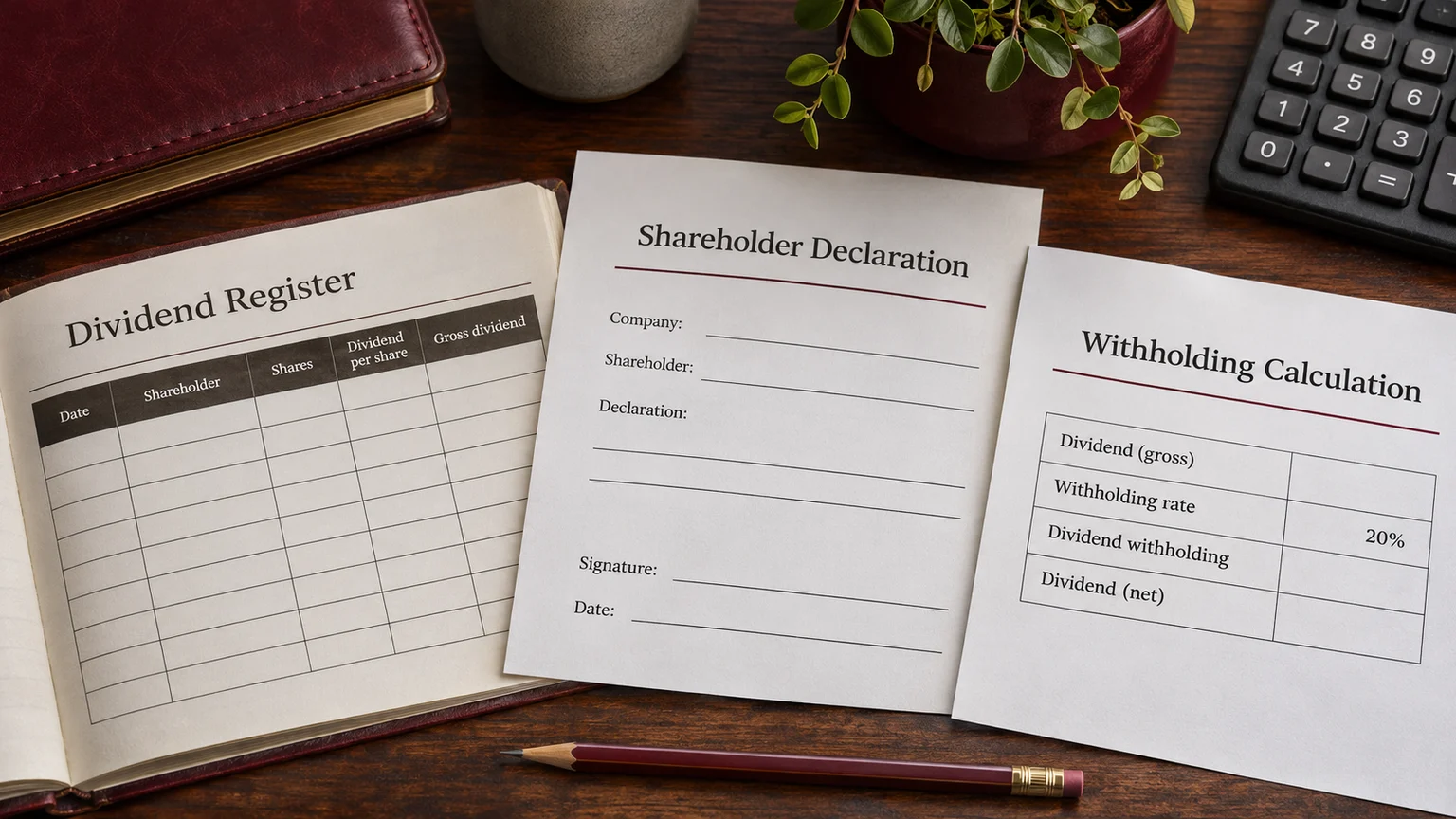
Gather the dividend resolutions or other records of the declaration, payment instructions, shareholder information and any tax declarations or supporting documents used to apply the claimed treatment. Check whether the documents relate to the correct shareholder and dividend, and whether they were in place when the company made its decision. A declaration that exists somewhere in the company’s files is not necessarily evidence for every payment to that shareholder.
These details are not administrative trivia. If the company cannot connect the payment to the person who beneficially owned it and to the basis for the claimed treatment, it may be difficult to explain why no tax was withheld. Equally, a missing or unclear document does not, by itself, settle the legal outcome. The facts and applicable requirements need to be assessed together.
Check the basis for the exemption or reduced rate
Once the transaction is clear, identify exactly why the company did not withhold tax. Was an exemption claimed? Was a reduced rate applied under a tax treaty? Or did someone assume that overseas residence alone meant no South African tax was due? These are different explanations and should not be treated as interchangeable.
The South African Revenue Service (SARS) guidance sets out conditions that apply to exemptions and reduced treaty rates, including declarations. A treaty rate is not a universal rate for every foreign shareholder. Whether a particular treatment was available depends on the relevant facts, the applicable treaty provisions and the required supporting material. Do not assume that a company’s past practice, a shareholder’s foreign address or a statement in an email establishes the basis for applying a particular treatment.
Review the declaration and other records against the specific dividend. Ask whether they identify the relevant shareholder and beneficial owner, support the exemption or treaty treatment claimed, and relate to the payment in question. Also check whether the company’s records show who reviewed the claim and what information that person relied on. The purpose is not to create a paper explanation after the fact, but to understand the decision that was made and the evidence available for it.
If the reason for non-withholding cannot be established, keep that uncertainty visible in the internal review. Do not turn an assumption into a legal conclusion. A sound assessment may depend on information held by the company, the shareholder or both, and the next step should follow from what the documents actually show.
Define the periods and evidence before deciding on a correction
After identifying the transaction and the claimed treatment, establish whether the issue is isolated or extends to other dividends. Review the relevant payment records and declarations for the periods that may be affected. A single payment can point to a broader process problem, but it does not prove that every payment was handled incorrectly. Conversely, a check limited to the first transaction may miss other dividends processed on the same assumption.
Build a clear record for each payment: the declaration or resolution, payment date and amount, recipient and beneficial owner, the treatment applied, and the documents relied on. Note any gaps or contradictions. For example, a payment record may name one shareholder while supporting documents refer to another entity. That inconsistency needs to be understood before the company decides whether the tax treatment was correct.
Keep the review focused on evidence, not just labels. “Foreign shareholder” describes a connection to the company; it does not establish the tax outcome. “Treaty rate applied” describes a decision; it does not show that the necessary conditions were met. The supporting documents and the actual ownership and payment facts are what allow the company to test those conclusions.
Only after defining the potentially affected periods and assembling the evidence should the company consider the appropriate response. The outcome may depend on details that are not apparent from a payment schedule alone. A review should distinguish what is established, what remains uncertain and what additional information is needed before taking action.
Consider voluntary disclosure carefully
If the review indicates that there may have been a tax default, a Voluntary Disclosure Programme (VDP) application may be one option to assess. It is not an automatic remedy for every instance of tax not withheld. Eligibility and potential relief depend on the facts, timing and other requirements, including what SARS already knows about the default.
That makes the order of steps important. First understand the dividend, the owner, the periods and the evidence. Then assess whether a voluntary disclosure is available and appropriate before approaching SARS. An incomplete or poorly supported account may not resolve the central questions, while contacting SARS without understanding its existing knowledge can affect the assessment of VDP availability or viability.
Unicus Tax Specialists SA advises on complex tax matters, including voluntary disclosures involving cross-border or offshore-related defaults. Unicus Tax can assess the circumstances and supporting record before a disclosure is considered. That assessment is case-specific; neither eligibility nor relief should be assumed in advance.
A VDP is also distinct from challenging an assessment. If SARS has already taken a position or issued an assessment, the procedural options need to be considered in that context rather than assuming a disclosure application replaces a dispute process. The relevant documents, dates and status of any SARS action will shape what should be reviewed.
What directors can take from the review
The immediate aim is not to reach the most comfortable conclusion. It is to establish a defensible account of what happened. That means identifying each dividend and payment date, confirming the beneficial owner, locating the declarations and other supporting evidence, and understanding the exemption or treaty treatment the company relied on.
From there, the company can define the periods potentially affected and consider its position with a clearer view of the evidence. If a document is missing, record that fact and determine whether it can be obtained or corroborated. If the records conflict, resolve the inconsistency before relying on one version. If the basis for non-withholding was an assumption, test it against the actual requirements and circumstances.
These steps do not predetermine whether tax should have been withheld or whether a particular route is available. They make the next decision better informed. In a serious tax matter, the quality of the evidence and the sequence of decisions can matter as much as the initial tax analysis.
Have the foreign-shareholder dividend reviewed
If your company paid a dividend without withholding tax, Unicus Tax can assess the transaction, supporting declarations, affected periods and potential next steps confidentially. Start with the dividend records and the basis for the treatment applied, so the review can focus on the specific question your company needs answered.